Tilfi Banaras just walked into Paris Fashion Week on Matières Fécales’ République runway
Montreal’s Matières Fécales staged The Ninety-Nine Percent at Place de la République with 99 models of color. The quieter receipt: Banaras label Tilfi handwove and embroidered saree textiles for the couture finale looks.
 Anika Rao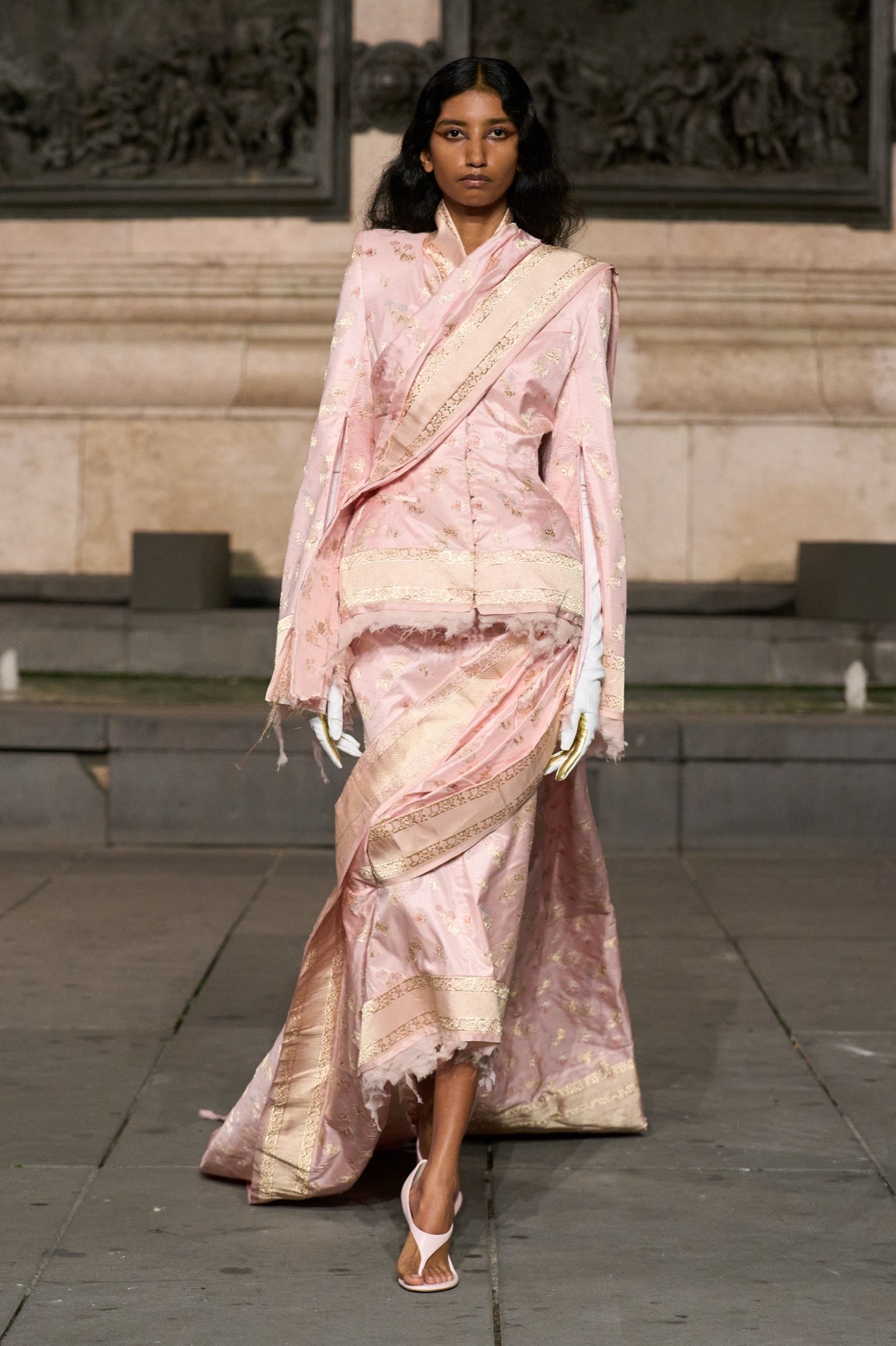
The pale pink look is the one worth keeping on the phone: structured jacket, pallu across the chest, white opera gloves, Banarasi shine with frayed edges.
On September 28 it walked Place de la République for Matières Fécales’ The Ninety-Nine Percent, and the fabric credit went to Tilfi, the Varanasi handloom house. Most of the timeline argued about sindoor makeup. The quieter fact is that a named Banaras atelier made the couture textiles on a Paris main-calendar runway.
Montreal co-founders Hannah Rose Dalton and Steven Raj Bhaskaran closed the first day of the spring 2027 season with 99 looks on 99 models of color. Last season they satirized luxury’s one percent at the old Paris stock exchange. This time the cast flipped, and Bhaskaran’s path out of low-income Montreal housing sat closer to the center of the show.
Family, Tribe, then Gods
The show ran about thirty-five minutes in three acts. Family opened in white and religious dress codes: thawb-inspired shirts, veiled chiffon, distressed linen, Louboutin curved-heel flip-flops. It closed with Bhaskaran walking beside his mother, Grace, his sister Shandeal, and his niece, all in white.
Grace was born in Guyana with Indian heritage, left school at nine to help raise seven siblings, and never learned to read or write. Bhaskaran has said the family once slept on one mattress in a small apartment while he sketched them in fantasy couture. That family walk is the show’s warmest beat, and it makes the later politics land harder.
Tribe pulled from the Montreal punk years: military tulle, distressed leather, Golden Touch gloves as a jab at how wealth treats talent. Three women in blue, white, and red closed the act.
Gods was the couture hope chapter, and that is where Banaras entered. Saris handwoven and hand-embroidered by Tilfi were remade as deconstructed jacket-and-drape looks and 1950s-volume ballgowns. Cabes GIE, a Burkina Faso network of about 2,400 organic-cotton artisans, supplied handwoven cotton for other evening pieces. The finale had models circling Marianne’s statue with lifelike billionaire dummies on their backs while Nina Simone’s “Tomorrow Is My Turn” played over the square.
The Banaras house on the call sheet
Tilfi is a working Banaras atelier, not a prop house. Founded in 2016 by Aditi Chand with Udit and Ujjwal Khanna, it grew out of a five-decade family textile firm after a weaver’s challenge pulled the founders home from international careers. The brand works only on handlooms, only with natural materials, and only in Banaras. It grew from about 300 artisans in 2016 to more than 2,000 today, selling through its site and flagship stores in Varanasi and Mumbai’s Ballard Estate.
Even the name is a technique: tilfi weaving runs three colored yarns without a break. The house turns that into a simple promise: pure materials, handmade production, Banaras provenance. Among the looks on République were a soft-pink jacket-and-pallu silhouette and a crimson gown with custom-dyed rose embroidery. The Varanasi workshop sat next to Cabes cotton and those 1950s Dior volumes in the same finale.
That credit is the part diaspora fashion readers should keep. Luxury shows have borrowed saree drape and Banarasi gleam for years without naming the workshop. This time Tilfi is in the notes.
Why the square mattered
Place de la République had never hosted a fashion show before. Bhaskaran called it a sacred place for voicing opinions and said it fit that immigrants staged the first one. Around 500 people waited through a public watch party for Rihanna, who sat near Rick Owens in a bronze Lurex tweed suit. A portion of collection sales supports La Maison d’Allanah, which helps LGBTQIA+ refugees in France.
Dalton and Bhaskaran are still early on the official calendar. They spent a decade as Fecal Matter, selling through Depop and orbiting Rick Owens, before Dover Street Market Paris folded them into its incubator for a March 2025 debut. After the prior season, Bhaskaran said wholesale orders had tripled. République scaled the cast, the politics, and the craft credits in one night.
Our read
The makeup discourse will move on. What should stick is a Varanasi craft house getting on-record credit inside a Paris protest-square finale designed by a Guyanese-Sri Lankan founder who once drew couture from a shared mattress.
Our take: watch whether Tilfi can turn this into European wholesale and lasting press language, and whether more Global South workshops ask for the same named credit the next time a luxury show wants their weave. Pair it with the Milan makeup-director ladder we mapped for Beauty by Rosh. Banaras made the notes. That is the Paris night worth keeping.