What US Asian youth culture looks like when it's really the mainstream
In Honolulu, Asian life spans Kalihi, Ala Moana, Waikīkī, and Kakaʻako without needing to perform for a white center. Mainland "Asian American" culture often sells the polished slice. Here the range just reads as local.
 Anika Rao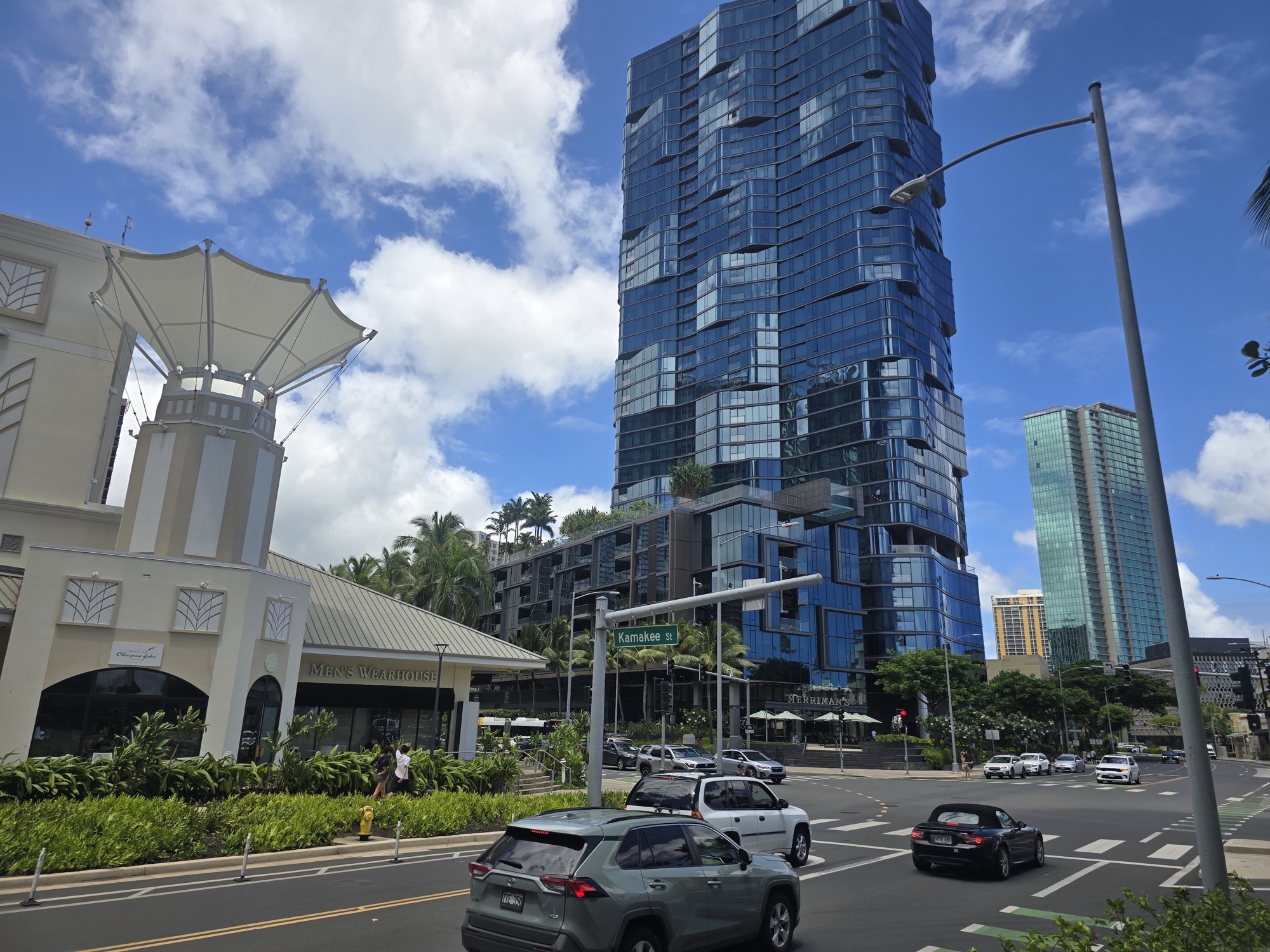
I grew up in a very white neighborhood, which means I learned early which versions of Asianness were allowed to be public.
Cute enough. Smart enough. High-achieving enough. The playlist, the skincare shelf, the airport drip that photographs well for people who are not us.
Even the stuff we love can arrive on the mainland already filtered into export-ready exoticism: polished, modern, easy to like. The part that travels. The part that makes non-Asians feel cultured without sitting with the whole messy range.
Then I spent time in Honolulu, and my shoulders dropped.
On Kamakee Street in Kakaʻako, the glass is doing what glass does in any expensive American city. Condos step up the skyline. Cars wait at the light. Palm trees sit in the landscaping like they belong to a HOA packet. Nothing about the corner is performing Asia for a visitor, and that quiet is what I came for.
The mainland edit
A lot of what continental America calls Asian American youth culture is real. It is also curated by proximity to whiteness.
K-pop that clears Western radio. K-beauty that fits a Sephora story. Festival premieres, ambassador campaigns, the diaspora creators who can translate without scaring the room. Goldscene covers that circuit because it moves money and taste. The receipts are real.
The frame is still incomplete. Soft power on the mainland still asks Asian culture to be interesting to a center that is not Asian. What travels hardest usually looks expensive, disciplined, photogenic, and lightly foreign. Auntie energy, broke energy, ugly parking-lot energy, the kid who is just annoying in a Target aisle: those rarely make the export reel.
Honolulu flips the math.
Where Asian is infrastructure
Honolulu County is about 43 percent Asian alone on recent Census figures, with white alone around 21 percent. Count Asian in combination and the share jumps higher still. Filipino and Japanese communities are huge; Chinese and Korean layers sit in the mix.
Native Hawaiian and other Pacific Islander identity is its own sovereignty story. Do not fold it into a catchall "Asian." Locals will correct you if you try.
University of Hawaiʻi sociologist Jonathan Okamura has argued for decades that "Asian American" is a mainland category with weak everyday traction in the islands. People talk local: plantation descendants, pidgin, attachment to place, a panethnic island identity that grew under haole power from Chinese, Japanese, Okinawan, Filipino, Korean, and other labor histories. Local is about belonging here, with politics attached. A mall directory of ethnic snacks does not cover it.
That is why an H Mart in Kakaʻako can feel like a normal grocery run instead of a pilgrimage. The chain opened its first Hawaiʻi store on Keawe Street in 2020, inside the Our Kakaʻako buildout, with a food hall upstairs and the same snack aisles mainland diaspora kids treat as a weekend destination. Here it reads closer to infrastructure.
Same with Nijiya at Ala Moana, Don Quijote, Times, the plate-lunch logic that does not need a heritage-month caption. Asian foodways are Tuesday.
Ala Moana, Waikīkī, Kakaʻako
Ala Moana Center is one of America's great malls, and it behaves like a city. Locals and tourists split the traffic. Japanese, Korean, and Chinese retail logic sits next to the usual American chains without needing a "K-beauty edit" banner to explain why the shelves exist. You can shop ultra-luxe and still feel like you are running errands.
Waikīkī is the tourism machine, so it packages exoticism for sale: brochure Hawaiʻi, paradise on a schedule. Locals still work there, party there, and roll their eyes there. The strip will always get mined for visitor fantasy. That does not cancel the Asian density living around it. Both are true at once.
Kakaʻako is the newer chapter. Between downtown and Waikīkī, the old light-industrial waterfront has been rebuilt into Ward Village glass, SALT at Our Kakaʻako murals and restaurants, reserved-housing towers next to market-rate ones, and a young-professional streetscape chasing a walkable city more than a resort.
Howard Hughes' Ward Village keeps stacking condos. Kamehameha Schools' Our Kakaʻako side keeps programming street life. The neighborhood is contested, expensive, and unfinished. It is also where Asian and local youth culture looks like tech workers, creatives, gym people, and condo kids, with nobody framing the sidewalk as representation.
Allowed to be the whole range
Mainland Asian America still gets flattened into model-minority success or niche cool. Honolulu makes room for the rest because the center of gravity is already Asian-Pacific.
You can be in Kalihi, one of the last working-class cores in urban Honolulu, with Filipino, Pacific Islander, and immigrant family density that outsiders still code as "the hood." You can be ultra luxe in a Ward tower. Student, service worker, startup kid, auntie on a Costco run. None of that has to narrate itself as Asian content. It just reads as local life.
That is what felt refreshing as someone raised where I was usually the exception in the room. For a few days the racial math stopped asking me to represent. I could just be.
I am not claiming visitor status turns into local status. It does not. Okamura would laugh. Locals can clock mainland Asian Americans in a sentence. Native Hawaiian politics are not resolved by a diaspora soft-power essay. Gentrification in Kakaʻako is real, and Kalihi residents have spent years saying they refuse to become "Kakaʻako West."
Still. If you only study Asian America through the export surface that non-Asians already like, you will keep mistaking the brochure for the city.
Our take: Honolulu is the control group. Keep covering the polished soft-power lane. It moves the mainland. Then remember what majority looks like when the edit is off: Kalihi and Ward glass, mall errands and mural blocks, H Mart as groceries, Asian faces as ordinary density. That fuller range is the culture. Packaging is what travels without it.